O-A: What wouldn’t you do without art? What did you discover, achieve with it?
Ana-Maria Panaitescu: For sure, art is a way of knowing myself. Is not the only way, but without art, I would know myself less.
O-A: What is a vivid memory of a remark concerning your art that got stuck with you?
Ana-Maria Panaitescu: The fact that many people who are looking at the objects I made ask the same question: “what is this?”. I feel flustered a bit, I consider it amusing and I still don’t know exactly what to answer.

O-A: What was the most interesting statement you heard about your work?
Ana-Maria Panaitescu: When I was a student, in the last year, very close to the end of studies, my art teacher told me that I will have a hard and tormented life because I paint from my head. This was 25 years ago.
A few days ago, an important art historian and curator from Bucharest, came to see my works in an exhibition; and he said: “Everything I see here is cerebral, you made it from your mastermind, but interesting, it is not rigid.” And I realised that indeed, my way of work daily is to do everything I can think and to hope that from time to time, an angel will come and flutter somehow, over me. If he finds me at work, great. If not, I’ll never know he was there. So, working daily is very important! The rest, we’ll see if it’s happened…
O-A: How do you search for inspiration and themes for your work?
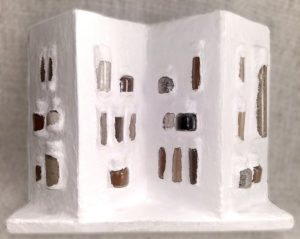
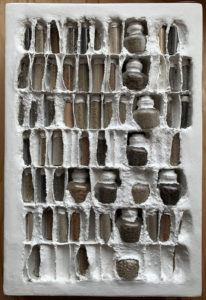
Ana-Maria Panaitescu: Many of my themes came from the mystical register. For example, I have more than twenty five years since I started to study The Goblet, in painting and as an object design/assemblage/collage, too. I also love to study the field of the geometrical forms for their perfection; at the same time I am very interested in using new materials, the materials that we use daily at the same time with noble materials like oil colors, and wood; I want to research, to see if these materials (silicon, polistiren, mousse board, acrylic, etc) can become precious, I like to see to what extent, “materia” can be spiritualized (which I think is the main purpose of artists).
O-A: How has your art changed over time? Why?
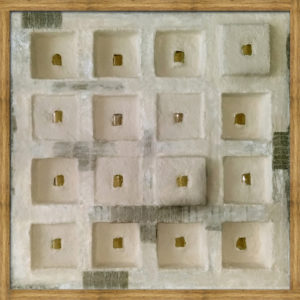
Ana-Maria Panaitescu: I think it becomes more simple, because when I read for the first time the idea of “Less is more”, it was stuck in my mind. So, I try to use just a few elements and to obtain as much as I can: for example, just white and some small reliefs; or very often, the serialist composition, which is very simple, but if you don’t treat it with very much attention, it can become boring; or just a line that can be “read” in a mass of color, using a strong composition and what the expression of oil colors brings to our eyes.
O-A: What names do you give your artworks?
Ana-Maria Panaitescu: Well, this is not easy for me. Usually my works are stages of a theme that I study for many years. And I don’t like the “story” when it is about fine arts. The stories are wonderful, but I don’t like to find a story in an image. I like to keep things about composition, color, line, dot, light, shadow, etc. and to offer emotions in this register, using these elements. Is not easy, because it is another “language” and there can be people that don’t make the effort to understand it. So, the cleanest way to give names to my works is to admit that I have these stages of a theme. This is why numbers came often after the name, like Goblet 1, 2, 3, or even Serialism 1, 2, 3, etc.